Katerina Katsan
Visual artist, photographer, Jerusalem
Katerina Katsan is a visual artist and photographer who lives and works in Jerusalem. She grew up in Murmansk, in the far north of Russia, and later moved to Israel.
She holds a B.F.A. from the Department of Photography at Bezalel Academy of Arts and Design, Jerusalem, and studied art before that at the Meyerhoff Center for Art Education. Since 2024 she has been the studio photographer of the Israel Antiquities Authority.
She works with direct photography, with a handmade lens that imitates a pinhole camera, with archival material, photomontage and AI tools, and many of her projects take shape as artist's books.
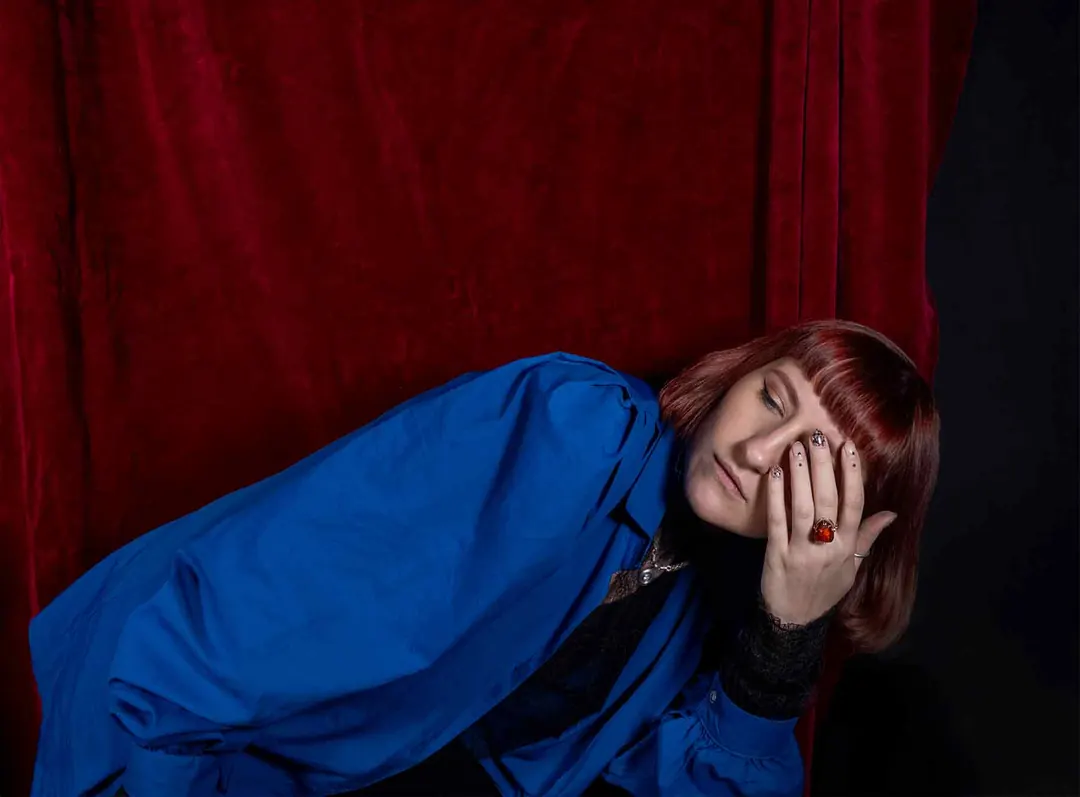
Untitled, 2025
Self-portrait, archival pigment print, 118 × 84 cm
Artist statement
My work begins with looking: at the feeling of home in water, at the body, at natural light, chaotic spaces, the authenticity of memory, at textures and anomalies that recall the place where I grew up in Russia, Murmansk. A home I lost because of the war between Russia and Ukraine, before I had managed to find a new one in Israel.
My work moves between documentation and imagination, between outside and inside, between presence and absence. Through photography I make spaces where reality is unsettled and turns into something unstable, almost foreign, and in the same breath comforting and accepting.
- How do you make work from a place you can no longer physically reach?
- How does transplanting a memory from one place into another change one's relationship with the work?
- What is the authenticity of memory, in emotional and in documentary space?
I find the places I photograph by looking for a kinship with home. Most often they are natural landscapes that recall the scenery of my childhood: love at first sight, even when they are geographically far from the memory itself. I choose them by emotional intuition.
I shoot with a digital camera, and sometimes, as part of the work, I use a lens I made by hand that imitates a pinhole camera. It lets me unsettle the sharpness of the image and create a sense of analogue instability, in which reality is seen distorted.
Alongside direct photography I bring archival material from Murmansk into photomontage, and use AI-based tools in an attempt to fill the gaps in material I have had no access to since the war between Russia and Ukraine began.
AI is not a substitute for photography here, but one more tool in the attempt to rebuild memory. Combining photographed images, archival material and newly generated images is how I make a visual space that exists between reality and fiction.
Working with memory also leads me to my own body, and sometimes I photograph myself as part of the process, bringing a personal presence into the spaces I build. Water is a central motif in my work: a passage where images come apart and are rebuilt, and the border between reality and memory wears away.
Most of my projects focus on a particular place, or create new places that develop over time. In the end they take shape as artist's books, where sequence and structure let me build a sustained experience rather than a single image.
For me photography is a way to test the limits of reality and to create an experience in which the viewer moves between recognition and estrangement, until they lose their full hold on the image. The difficulty of facing two wars at once turns me towards memories, and through my work I build an alternative world that makes it possible to cope with reality.
I want to keep developing the work with archival material and newly generated images, and to find out how much further the border between documentation and creation can be pushed, so that an image changes its nature intuitively. I want to explore how to build systems of images with no single clear point to hold on to.